

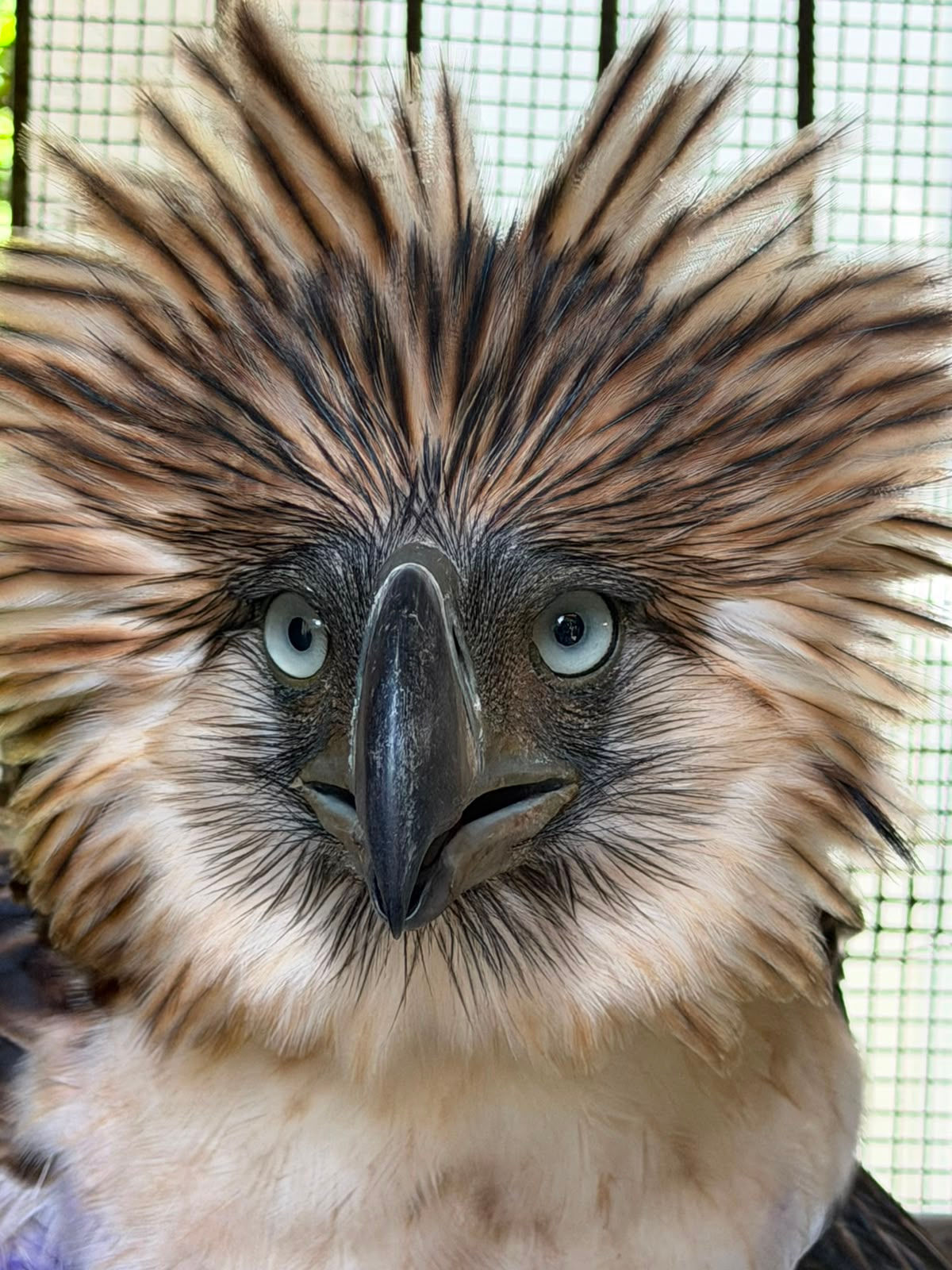
JUVENILE Philippine Eagle Sawaga-Dalwangan continues to recover under intensive veterinary care.
In a statement on Wednesday, July 16, the Philippine Eagle Foundation (PEF) said that Sawaga-Dalwangan is now alert and responsive, almost two weeks after its rescue last July 3.
“She is eating on her own, her wounds are clean, and the maggot infestation is gone. She has completed her antibiotics and other medicines, and there are no signs of an active infection,” PEF said.
When the eagle was rescued and received initial veterinary care, she was weak, dehydrated, and unable to eat on her own.
The foundation said she had acquired wounds and a severe maggot infestation on her wings, abdomen, and tail area.
X-rays of her body showed two metal pellets in her body, one in her right wing and another in her left thigh.
“The veterinary team gave her fluids, wound treatment, antibiotics, pain medicine, assisted feeding, and continuous care,” PEF said.
The foundation said veterinarians successfully removed the small metal pellet from her wing, which measures more than half a centimeter in diameter.
The other pellet remains deep inside her left thigh and will be under close watch.
The foundation stressed it will be subject to removal, but will be done if she has fully recovered and is strong enough for the procedure.
Sawaga-Dalwangan also tested negative for Avian Influenza, according to its tests done by the Regional Animal Disease Diagnostic Laboratory XI of the Department of Agriculture XI in Davao City.
Meanwhile, the results for Newcastle Disease and Aspergillosis are still pending.
“These three diseases are serious health threats to eagles and other birds,” PEF said.
It noted that Avian Influenza and Newcastle Disease are highly infectious viral diseases, while Aspergillosis is a fungal infection that can be fatal, especially in weak or stressed birds.
Sawaga-Dalwangan was believed to be a female, but blood samples will be sent to the University of the Philippines Diliman to confirm the eagle’s sex through DNA testing.
“The samples will also be studied to help identify her possible ancestry, geographic origin, and genetic relationship to other known Philippine Eagle populations,” PEF added.
At present, Sawaga-Dalwangan is receiving intensive care at Dr. Bayani’s Animal Wellness Clinic, but will be transferred to the Philippine Eagle Center’s quarantine facility in Malagos, Davao City once all disease test results are negative and she is medically stable.
The eagle will continue her rehabilitation, monitoring, and recovery at the PEF quarantine facility in Malagos.
It can be noted that Marvin Linoy rescued the eagle with help from the Daraghuyan Ancestral Domain Indigenous Political Structure and the Inhandig Tribal Multi-Purpose Cooperative.
The community immediately turned the eagle over to the Department of Environment and Natural Resources and the City Government of Malaybalay for proper coordination and immediate emergency care.
The initial checkup showed the combination of dehydration, soiled feathers, damaged plumage, and the advanced maggot infestation suggests the injuries were not recent and she had been unable to move for several days before the rescue.
PEF pushed for a multi-agency investigation of the rescue of the Philippine eagle.
The eagle was found near the Sawaga River in Barangay Dalwangan in Malaybalay City.
Barangay Dalwangan lies within the Mount Kitanglad Range Natural Park, one of the Philippine Eagle’s key strongholds.
The area holds the second-oldest known breeding territory for the species, with nesting activity documented continuously since 1986, making it one of the longest-monitored Philippine Eagle nesting territories in the world.
Photo Philippine Eagle Foundation