




- EDCOM 2: Only 1 in 4 Davao City senior high readers needs no guidance
ONLY ONE in four Grade 11 senior high school (SHS) learners in Davao City can read independently, while nearly half remain at the “frustration level,” the Second Congressional Commission on Education (EDCOM 2) data show.
The data are sourced from the Department of Education SHS Literacy and Numeracy Assessment (SHS-LNA) conducted at the end of School Year 2025-2026.
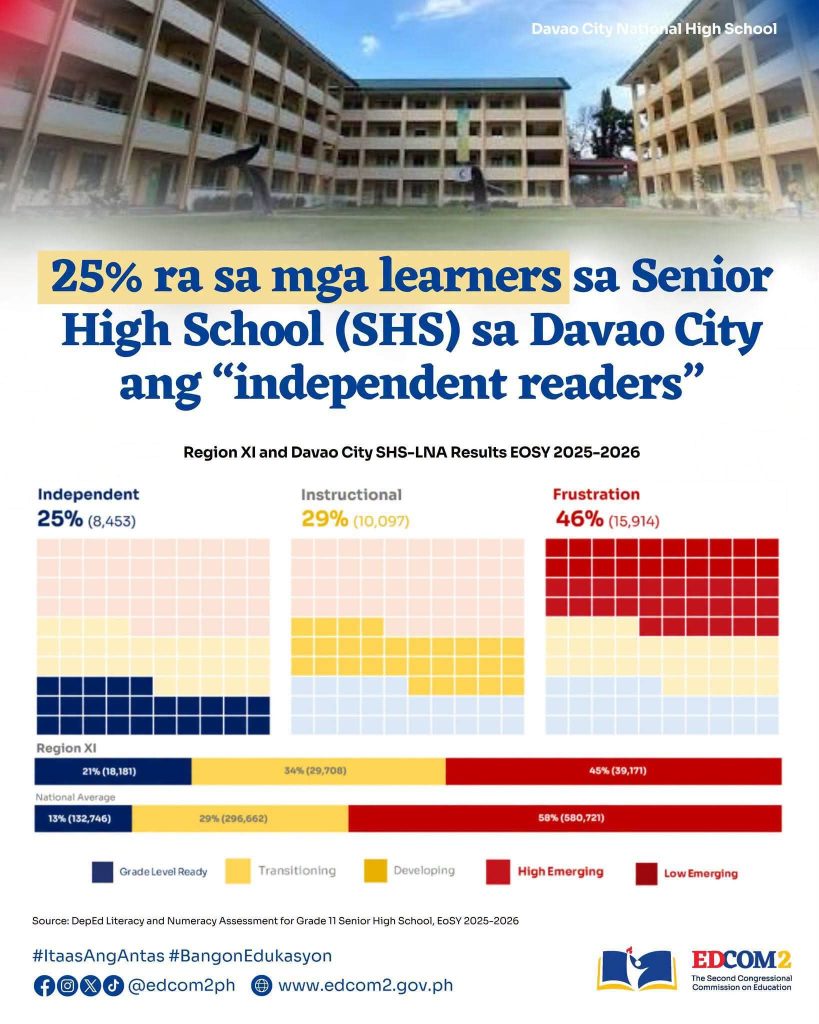
The data showed that 25% of assessed Grade 11 learners in the city, or 8,453 students, were classified as independent readers.
Another 29 percent (10,097) were instructional readers, while 46 percent (15,914) were frustration readers.
Independent readers refer to learners who have developed the reading proficiency needed to read, comprehend, interpret, and apply information with greater independence.
Rey Solitario, Davao City Schools Division superintendent, said the results present both a significant achievement and an urgent call to action for the Philippine education system.
“While this figure is a cause for concern, it also highlights the importance of strengthening literacy interventions as learners move toward higher education, employment, and lifelong learning,” Solitario said.
Independent readers are those rated “Grade Level Ready,” while instructional readers are those in the “Transitioning” and “Developing” levels.
Frustration readers are those in the “High Emerging” and “Low Emerging” levels.
Solitario said being at the frustration level means learners may struggle to understand texts independently, potentially affecting their performance not only in English but also in mathematics, science, and other learning areas that require comprehension and critical thinking.
“These figures underscore the need for more focused, sustained, and responsive interventions,” he stressed.
For DepEd Davao City, Solitario said these results strengthen the division’s commitment to intensify literacy programs, provide targeted support to struggling readers, and empower teachers to use effective, evidence-based reading strategies.
“The ARAL Program, school-based reading initiatives, differentiated instruction, and collaborative efforts among teachers, school heads, parents, and external partners must work together to address learning gaps and ensure that no learner is left behind,” he said.
It can be noted that Davao City results performed better than Region XI and national figures.
In Region XI as a whole, 21 percent of learners (18,181) were independent readers, 34 percent (29,708) were instructional readers, and 45 percent (39,171) were “frustration” readers.
Nationally, only 13 percent (132,746) were independent readers, 29 percent (296,662) were instructional, and 58 percent (580,721) were “frustration” readers.
The regional comparison shows that most regions have more than half of their SHS learners at the frustration level, and only Region XI, Region VIII, and the National Capital Region (NCR) fall at or below the 50-percent mark.

