


THE UNIVERSITY of Mindanao-Institute of Popular Opinion (UM-IPO) conducted a survey from July 16, 2026 to July 26, 2026 to gather the opinions of 1,200 Dabawenyos across three districts regarding the safety and security measures implemented in schools across the City.
Specifically, the survey assessed student, parent, and guardian perceptions regarding school safety and security within Davao City. It examined accountability ownership, attitudes toward lowering the minimum age of criminal liability, and contributing factors to violent behavior among learners. Finally, it gathered stakeholder recommendations to enhance local school security measures.
Since the survey was conducted online via sponsored ads on Meta Platforms (Facebook, Messenger, and Instagram), including email, IPO relied heavily on online, pre-defined, targeted social media users who met the inclusion criteria and were contacted within the defined geographical radius. Respondents were defined as parents/guardians, students aged 18 or older, with valid/active email addresses, and residents of Davao City. The survey was done at a 95% confidence level and a +/- 2.83% margin of error.
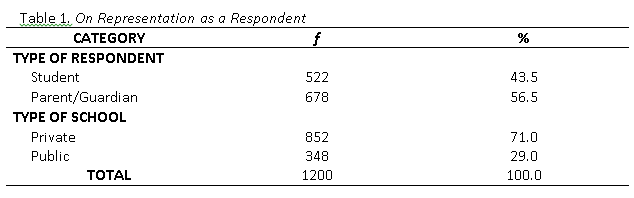
Among the 1200 respondents, parents/guardians made up the majority (n=678, 56.5%), with students comprising the remainder (n=522, 43.5%). When asked about schools where the children/students were affiliated, three-fourths (71.0%) of the respondents were affiliated with private schools while the remaining 29.0% were affiliated with public schools.
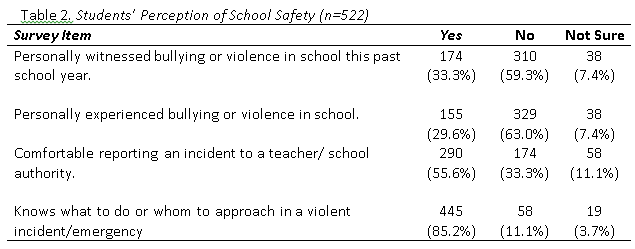
When asked about their perceptions of school safety, roughly 3 out of 10 students (n=174, 33.3%) reported having witnessed bullying or violence at school, and 3 out of 10 (n=155, 29.6%) reported having personally experienced it. Approximately 9 of the 10 respondents (n=445, 85.2%) said they know what to do or whom to approach during a violent incident or emergency; however, approximately 6 out of every 10 students (n=290, 55.6%) expressed confidence in reporting an incident to a teacher or school authority.
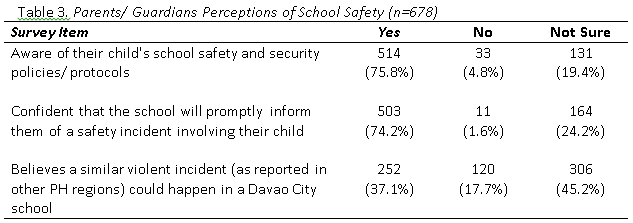
When parents/guardians were asked about their awareness of school safety protocols, approximately 8 out of 10 (n=514, 75.8%) responded that they were aware, and 7 out of 10 parents/guardians were confident that schools would promptly notify them of a safety incident (n=503, 74.2%). Moreover, 4 out of 10 parents/guardians (n=252, 37.1%) believed that a similar violent incident to those reported elsewhere in the Philippines could happen in a Davao City school.
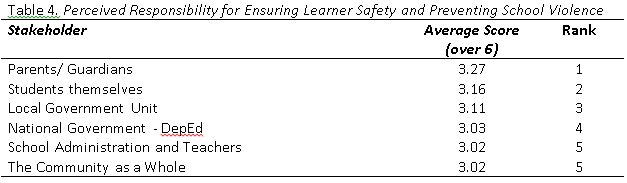
When asked who holds the highest responsibility for learner safety, respondents ranked parents/guardians first and students themselves second. The local government unit ranked third, followed by the Department of Education as fourth, and by the least accountable: school administration and teachers, and the community as a whole, which both obtained a mean score of 3.02.
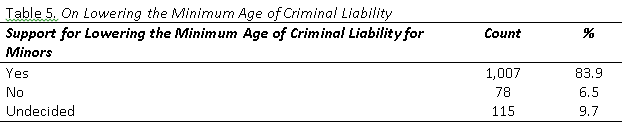
When asked about their support for lowering the minimum age of criminal liability, 8 out of 10 respondents (n=1007, 83.9%) expressed their support.
Of those who supported the call for lowering the minimum age of criminal liability, 6 out of 10 Dabawenyos preferred to lower it to 12-14 years old (n=562, 55.8%) while approximately 3 out of 10 Dabawenyos (n=348, 34.6%) preferred 9 to 11 years old and the remaining 1 out of 10 Dabawenyos preferred to lower it to below 9 years old (n=97, 9.6%).

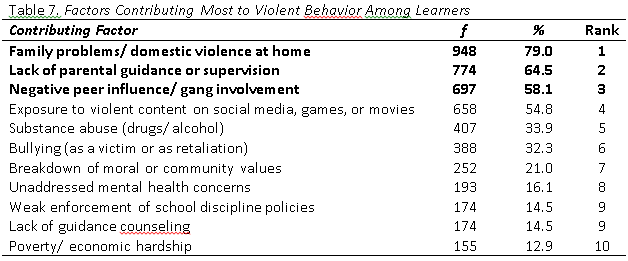
When asked about their perception of the contributing factors to the violent behavior among learners, family-level factors dominate the perceived causes: family problems or domestic violence at home ranked first (n=948, 79.0%), and lack of parental guidance or supervision ranked second (n=774, 64.5%). Negative peer influence/ gang involvement ranked third (n=697, 58.1%), while exposure to violent content on social media, games, or movies (n=658, 54.8%) and substance use (n=407, 33.9%) ranked fourth and fifth, respectively.
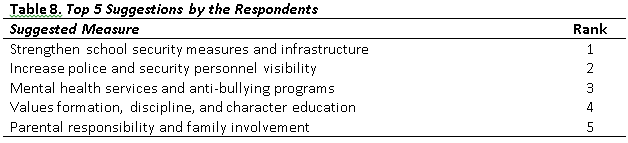
Lastly, respondents were asked qualitatively about their suggestions for improving the safety and security of schools within Davao City; strengthening school security measures and infrastructure ranked first, followed by increasing police and security personnel visibility. Mental health services, anti-bullying programs, and values formation, discipline, and character education were among the most suggested measures. Among the most suggested, parental responsibility and family involvement ranked fifth.
Note: The University of Mindanao funded this survey through the Institute of Popular Opinion.